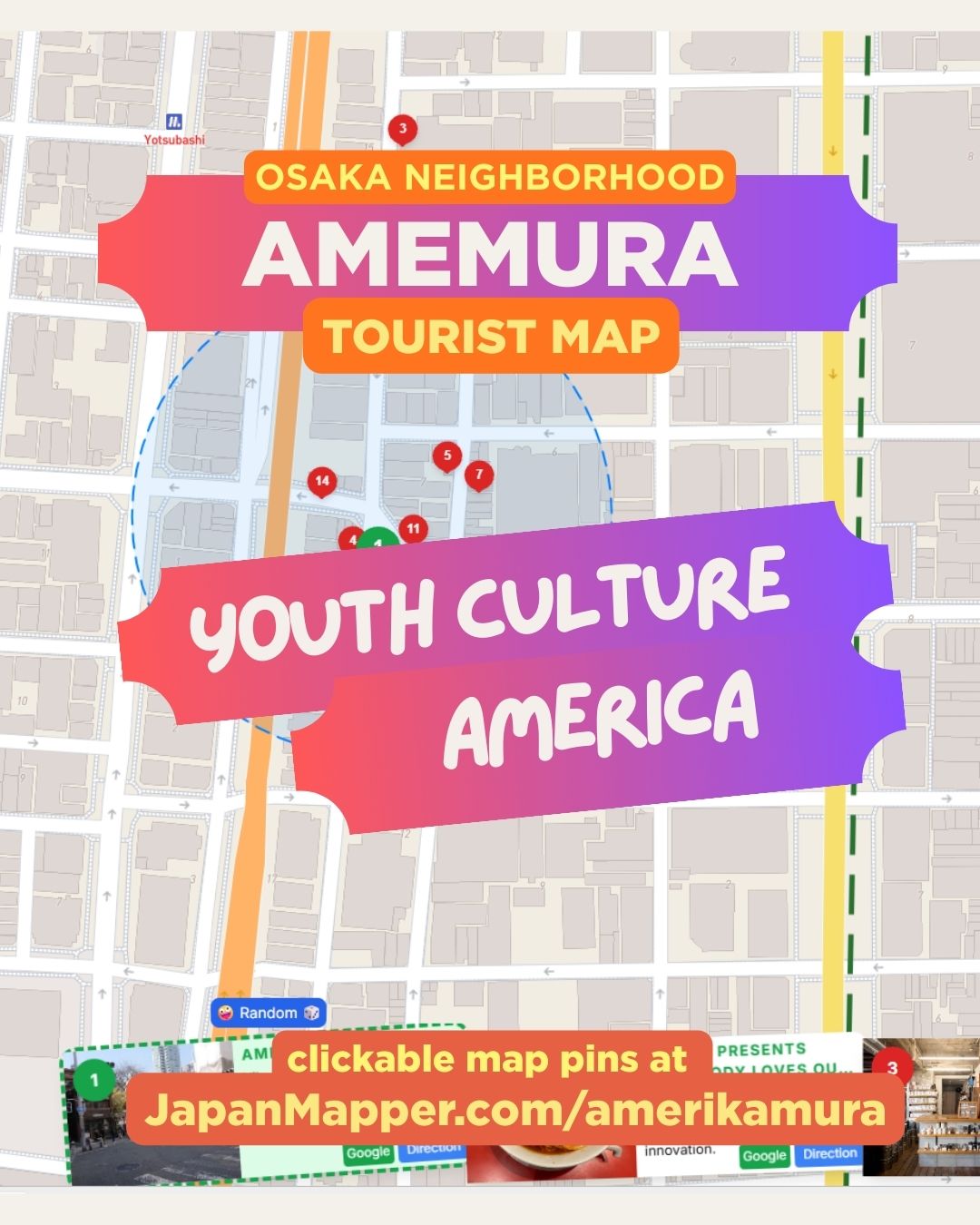
Osaka's Rebellious Heart, Where American Cool Became Something Entirely Japanese
There's a comparison that gets made constantly: people call Amerikamura the "Harajuku of the West." It's not wrong, exactly, but it undersells something important. Where Harajuku feels curated — a polished stage for fashion performance — Amemura, as locals call it, feels like the party happening behind the stage. Grittier, louder, less interested in your approval.
It is, in the best possible sense, purely Osaka. The neighborhood covers a relatively small area but contains enough layers to fill an afternoon easily.
How a Charcoal Warehouse District Became a Cultural Landmark
In the 1960s, this area was known as Sumiyamachi — Charcoal Shop Town — a quiet cluster of warehouses with no particular identity. The shift began in 1969 when a designer named Mariko Higiri opened Café Loop, envisioning a late-night gathering place for creative types. It attracted the right people, and the empty warehouses around it started filling with imported goods from the American West Coast: surfboards, Levi's, vinyl records.
By the 1980s, the "American Village" nickname had stuck, and the neighborhood had developed a character that was simultaneously in love with American pop culture and entirely its own thing. That tension — between influence and identity — is still what makes Amemura interesting today.
The Landmarks That Define the Neighborhood
Triangle Park (Sankaku Koen) is the neighborhood's anchor, and it looks nothing like a park. It's a concrete triangle. No grass, no trees — just steps, skateboard wheels, and an ever-rotating cast of fashionistas, students, and people eating takoyaki with nowhere particular to be. It functions as Amemura's living room, and the people-watching here is among the best in Osaka.
Look up while you're there and you'll spot a miniature Statue of Liberty perched on a nearby rooftop — one of those inexplicable neighborhood details that has become, over time, completely essential to the area's identity.
Big Step, the shopping complex nearby, manages to be genuinely cool rather than just large. Streetwear, a pinball arcade, and live music venues occupy the same building in a combination that shouldn't work as well as it does.
On Screen and in Print
Fans of the film Josee, the Tiger and the Fish will recognize Amemura's streets as the backdrop for the film's quieter, more exploratory sequences — the neighborhood's texture suits its tone well. The area also appears regularly in Japanese youth dramas, where its neon alleyways serve as shorthand for a particular kind of urban freedom.
On weekends, the streets themselves become something close to an unofficial convention. Gothic Lolitas, cyberpunk enthusiasts, vintage collectors, and skaters share the same sidewalks without any apparent friction. The neighborhood has always attracted people who take their aesthetic seriously, and that hasn't changed.
What You'll Find Off the Main Streets
Mittera Kaikan looks, from the outside, like an unremarkable building of mild disrepair. Inside, it's a vertical collection of tiny, highly specific bars — heavy metal rooms, goth dens, retro gaming spaces — stacked on top of each other in a configuration that feels more like a subculture apartment block than a standard nightlife venue. It rewards exploration.
The "Birdman" Mural — officially titled Peace on Earth, painted by artist Seitaro Kuroda — has occupied a wall here since the 1980s. A large, colorful dove rendered in the kind of bold, confident lines that age well, it has become one of the neighborhood's most photographed and most quietly significant landmarks.
Alice on Wednesday requires you to crouch to get through the entrance — a small door that opens into an Alice in Wonderland-themed boutique. The whimsy is deliberate and fully committed, which makes it work.
And throughout the neighborhood, look at the lamp posts. Each one is designed to resemble a human figure in motion — dancing, posing, mid-gesture. It's a small detail that adds up across an entire district, giving the streets a quality of inhabited, slightly surreal life even when they're quiet.
On Vinyl, Vintage, and Who Actually Comes Here
Misconception: "It's just for teenagers." The street culture skews young, but the record stores — including Time Bomb Records, which stocks serious collections of 1970s punk and 1990s hip-hop — draw committed collectors of every age. If you care about vinyl, Amemura has depth.
Misconception: "It's a place for Americans." The name is the only American thing about it. What Amemura represents is what happens when Japanese youth culture absorbs an outside influence and rebuilds it entirely on its own terms. The rock, the skate culture, the denim — all of it has been filtered through an Osaka sensibility until it became something new. There is more Osaka soul here than American anything.